Flinders Overseas Health Group, May 2026 Ultrasound Training for Maternal and Neonatal Health:
Background and Overview
The Flinders Overseas Health Group (FOHG) Maternal and Neonatal Health (MNH) team have undertaken significant activities over the years to support ultrasound skills development in Nagakeo Province.
The 2025 Ultrasound Skills Course
In 2025 FOHG collaborated closely with the Nagakeo Provincial District Health Department to upskill the ultrasound skills of mainly medical staff through a dedicated workshop over a week. The Health Department organised a schedule for pregnant women to attend throughout the week.
Three FOHG specialist sonographers provided individual instruction for participants to gain hands on experience.
The data from that initial training indicated a positive impact, with participants’ confidence rising from 2.6% before the course to 8.4% after hands-on skills transfer session.
Team FOHG and participants from 2025.
2026 Follow-Up Visit
This year in May, an expert team aimed to assess the effectiveness of the 2025 training. The 2026 FOHG team consisted of obstetrician/gynaecologist Dr Kristen Barnden and sonographer Ms Kerrie Howard, both volunteering their expertise. Dr Helen Bradley worked alongside Pak Finsen from the Health Department facilitated, scheduled the program and followed up with focus group discussions (FGD).
This allowed the team to gauge the level of confidence developed by participants to function within their own workplace, taking into consideration any workplace constraints such as equipment malfunction. Where machines were unavailable due to breakdowns, Pak Finsen arranged for temporary replacements.
Individual Support
At each centre, typically two doctors were present, and up to six pregnant women daily were invited for ultrasounds under FOHG supervision. These sessions provided doctors with opportunities for constructive feedback and scanning practice across a range of stages and possible conditions during pregnancy.
Extended hands on practice
Site Visits and Practical Sessions
FOHG visited five regional puskesmas: Jawasika, Kuburea, Boawae, Nongororo, and Pratama Raja (a small new hospital). This was no mean feat as the rain was consistent and the roads were near impassable at times.
A road or a river?
However, regardless of the water, pot holes and animals on the roads, we successfully visited the five destinations.
Children enjoying the expanse of water which makes driving difficult and causes holes in the road.
Focus Group Discussions and Outcomes
At the conclusion of each day, FOHG conducted focus group discussions with participants and bidan (midwives). Participants reported increased confidence in scanning and a greater understanding of normal ultrasound findings after the 2025 course. They felt more prepared to refer patients to the newly appointed obstetrician/gynaecologist at Aeromo Hospital and more capable of explaining to women the necessity of ultrasound and referrals to RS (hospital).
Participants highlighted the value of hands-on instruction, noting that it had significantly boosted their confidence. The training had changed outcomes for some women: examples included detection of cysts, growth retardation (IUGR), and retained products after abortion.
Feedback on Training and Mentorship
Participants were enthusiastic about this FOHG visit, expressing that the original course had insufficient time for practical experience due to competition with others and brief sessions. This follow-up visit to individual workplaces offered more time for mentorship, discussion, and learning advanced skills. After the 4–5 hour session participants felt their abilities had markedly improved compared to the previous training. Another round of visits supporting those participants who missed being mentored on this trip will be instigated in the near future as it can be seen to be very beneficial.
Future Needs and Continuing Support
Participants agreed that further training, especially in gynaecological scanning (e.g., ectopics), would be beneficial. They now appreciated ongoing support, such as consulting the specialist at RS. Aeromo via Facetime for clarification. FOHG was pleased to learn that this was Dr Polo Ishak Kurniawan, previously identified as a potential trainer during FOHG’s first visit in 2014. He had returned to the region after specialising in Obstetrics and has a special interest in US. He is carrying on the sustainable model of training FOHG have championed in this area.
Many of the bidan (midwives) reported that many of the participants instructed by FOHG had provided training for them as well. They hoped they would also be soon allowed to conduct US as many midwives elsewhere do. At the new RS Pratma Raja, bidan asked for further basic emergency obstetric and neonatal courses (BEONC).
Broader Application of Ultrasound
Of particular interest, participants reported using ultrasound for general medicine cases, such as diagnosing gall stones, and emergencies when the opportunity arose.
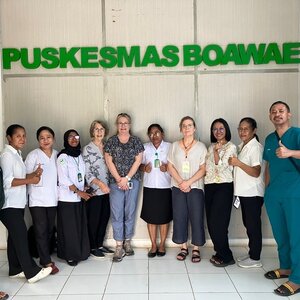
Team FOHG and Boawae staff.
Dr Helen Bradley,
MNH Team Leader